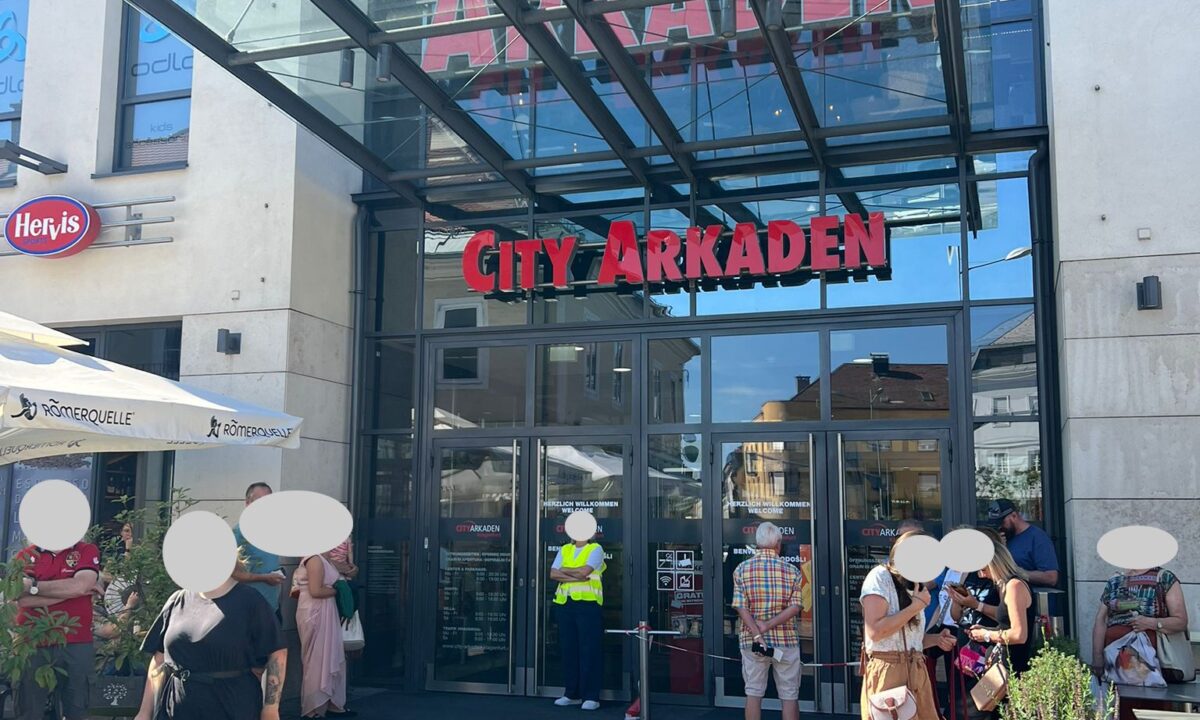
The recent evacuation of the Cityarkaden provides important insights into the reality of evacuations and shows a clear need for improvement in dealing with emergency situations. Although the evacuation was completed in just a few minutes, crucial findings came to light that point to general weaknesses and misunderstandings among the population regarding safe behavior in an emergency.
A key finding of the evacuation was that civilians are hardly familiar with the correct behavior in emergency situations. It was particularly striking that less than 10% of customers used the marked escape routes. Instead, most left the building via the main entrances, which seemed more familiar and therefore safer. Many people found the escape routes unpleasant and potentially threatening due to their design - narrow, bare corridors, loud loudspeaker announcements and unfamiliar surroundings - which also contributed to the perception that these routes were dangerous and not safe.
This observation underlines a fundamental problem: people are barely aware of escape route markings and are not systematically taught practically anywhere. Even schools focus on orderly evacuation in groups during annual evacuation drills, but do not teach people how to behave in unfamiliar environments. As a result, people intuitively rely on familiar routes in an emergency, even if they are not safe or suitable.
Another important finding concerns the distinction between buildings with staff who know their way around and those that are primarily used by customers or guests. While employees of a company or facility are often at least fundamentally familiar with the building, visitors lack this orientation. Shopping centers, hotels and public facilities in particular face special challenges here.
The exercise also showed that the presence of security or internal personnel during evacuation exercises can distort the results. People rely more heavily on these personnel in exercises, but this does not necessarily correspond to realistic conditions and therefore provides a distorted picture of actual evacuation capacities.
Need for discussion
It is therefore essential that there is an open and honest discussion about evacuation and evacuation. A uniform concept cannot apply equally to all situations and buildings, as each scenario - whether in the healthcare sector such as hospitals and retirement homes, in shopping centers or office buildings - requires specific approaches and measures. It is also important to clearly define the areas of responsibility. Not every evacuation is necessarily a case for the fire department or fire protection, especially as evacuations today are often triggered by general security threats such as bomb threats or amok attacks.
To optimize safety in the event of an emergency, companies and facilities must invest more in preventative measures and targeted training. These include comprehensive orientation measures for visitors and customers as well as clear communication and signposting of escape routes. In addition, regular and realistic drills must be carried out that are tailored to the specific characteristics of each building and user group.
Let's use the experience gained from the evacuation of the Cityarkaden to initiate a broad social dialog on emergency management and evacuation strategies. Only by continuously improving and raising public awareness can we ensure that people not only act quickly in an emergency, but above all safely.
Be part of the solution and actively engage in better understanding safety and emergency response in your company and community.
Legal reference:
Auch im §45 AStV (Arbeitsstättenverordnung) ist geregelt, dass Räumungs- und Brandalarmübungen für Betriebe mit Brandschutzbeauftragten jährlich durchzuführen sind.