Anyone running a company today is not only competing for customers, markets and technologies, but also in an invisible competition for credibility, legal certainty and strategic unassailability. While many focus on turnover, growth and innovation, they overlook a silent but decisive factor: complete and intelligent documentation.
Documentation is not just a "folder full of papers". It is an instrument that secures billions in value in the background. Those who understand it, who systematically build it up and maintain it, gain an advantage that goes far beyond individual projects: protection against attacks, resilience against crises and strength vis-à-vis authorities, investors and partners.
1. why documentation is more important than ever today
The rules of the game for companies are changing with increasing speed. New laws, stricter controls, rising expectations from society - all this means that entrepreneurs not only have to be successful in the present, but can also prove their past at any time.
A company without documentation is like a palace without a foundation. It may shine, it may impress - but the first storm reveals its weaknesses. Properly managed documentation, on the other hand, looks inconspicuous, but it has the power to turn crises into opportunities.
Example: A hotelier who has perfectly documented his fire protection and environmental requirements will not be surprised by an official inspection. Instead of having to frantically gather evidence, he presents orderly documents, refers to test reports and presents a comprehensible history. The result: the procedure is completed in minutes, while other companies struggle for weeks.
2. legal anchoring - documentation as a compliance weapon
In Austria - and similarly in other countries - the documentation obligation is not a side issue, but part of a company's legal DNA.
- § Section 82b GewO 1994 obliges entrepreneurs to regularly check compliance with all licensing requirements. Without documentation, this obligation is practically impossible to fulfill.
- Plant licenses, environmental requirements, employee protection regulations - they all require that evidence is not only provided but also archived.
- In the event of disputes or approval issues, what is not documented does not exist.
This makes documentation the ultimate compliance weapon. It determines whether a company is vulnerable in an emergency - or unshakeable.
3. economic dimension - from a duty to a billion-dollar factor
Documentation is often seen as a cost factor. Folders, expert opinions, test reports - they cost time and money. But in reality, documentation is a value-adding tool.
Let's look at investors:
No private equity fund, no bank and no international partner will invest in a company whose legal basis is uncertain. Complete documentation signals reliability, reduces risks and increases the valuation. In some sectors, it even determines whether a company will survive or go under.
A concrete example:
A production company wanted to expand and needed outside capital. Two competitors approached investors at the same time. Both had comparable products and markets. However, one presented complete approval files, evidence of environmental regulations and a clean compliance history. The other could only deliver bits and pieces. The result? The first company received financing, the second went bankrupt.
4. documentation as a protective shield against authorities
Many entrepreneurs see authorities as opponents. But in reality, they are merely guardians of the law. Whoever documents transforms this relationship: instead of playing a defensive role, the entrepreneur acts as a partner.
Authorities check according to clear criteria. They want evidence, facts, documents. Those who can provide these save time, nerves and, above all, costs. If you don't have them, you risk penalties, delays and - in the worst case - being banned from operating.
This is where the true power of documentation is revealed: it transforms uncertainty into sovereignty.
5. international dimension - why documentation decides globally
The global economy is networked. A company in Austria can have partners in Dubai, investors in New York and suppliers in Asia. The following applies everywhere: trust is not only created through words, but also through verifiable facts.
International standards such as ISO certifications, ESG criteria and environmental reports are all based on documentation. Those who maintain them consistently automatically play in a higher league. They become visible to international players, while competitors remain at a regional level.
6. psychological component - the inner peace of the entrepreneur
In addition to all the economic and legal arguments, there is one effect that is hardly noticed: inner peace.
An entrepreneur who knows that his documentation is correct sleeps better. He does not live in fear of an unannounced inspection. He does not postpone decisions out of uncertainty. He can concentrate on growth, innovation and strategy because the basis is secure.
This inner stability radiates outwards. Employees sense it. Partners trust it. Customers notice it. Documentation thus becomes an invisible asset that generates returns on a daily basis.
7. checklist: The path to unassailable documentation
A system is needed to ensure that documentation becomes a strength rather than a burden. The following steps have proven themselves in practice:
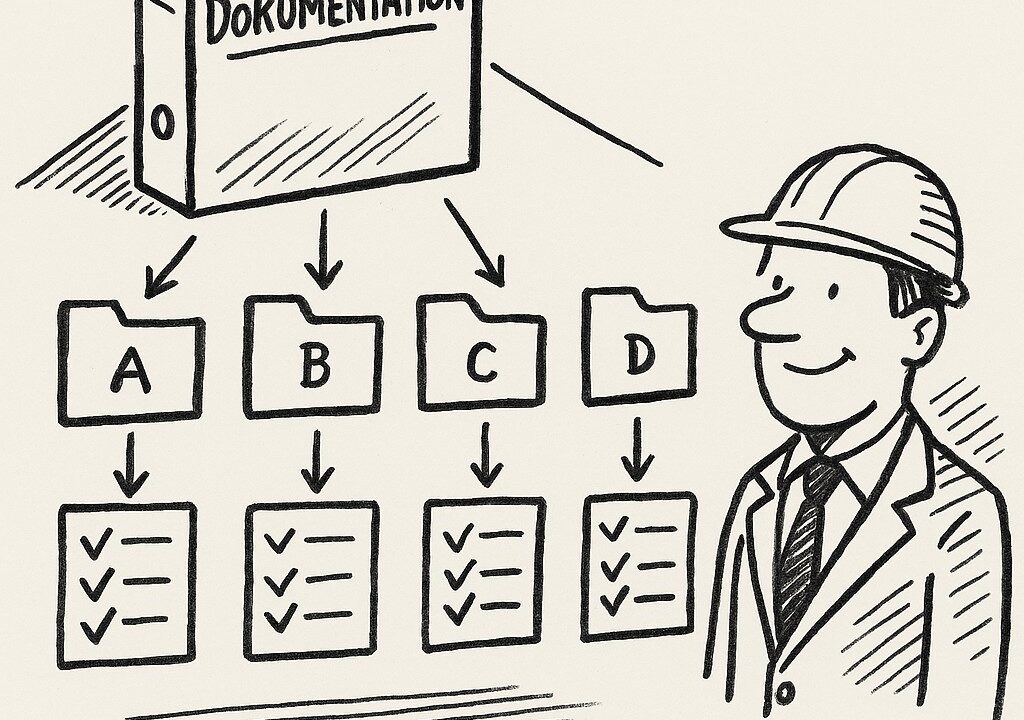
- Inventory: What permits, conditions, expert opinions and test reports exist?
- Structuring: Organize all documents by topic and relevance.
- Digitization: Secure digital storage prevents chaos and loss.
- Regular updates: Immediately incorporate changes to the system or the law.
- § 82b inspection: Annual self-inspection and documentation of evidence.
- External support: experts check gaps and supplement the documentation.
- Create visibility: Immediate access to complete documents when needed.
8 Vision: Documentation as an instrument of power
The most successful entrepreneurs of our time see documentation not as a duty, but as an instrument of power. They know: Every piece of paper, every signature, every audit trail is a building block in a bulwark that protects their life's work.
In a world that is becoming ever more complex, networked and fast-paced, the winner is not the one who makes the loudest noise, but the one who is best prepared. Documentation is the silent key to billions in value - because it is the only foundation that remains unassailable.
Final thought:
Documentation is not a paper graveyard. It is a strategic decision.
Those who ignore it are playing a game with an unpredictable outcome.
Those who master it are not just building a company - they are building an empire.