When we talk about architecture, planning and construction, most people immediately think of visible elements: Forms, materials, rooms, facades. But the true power of architecture often lies in the invisible. It is the structures that you don't recognize at first glance, but which determine whether a project runs smoothly, whether it is approved by the authorities, whether insurers have confidence and whether a company creates long-term value.
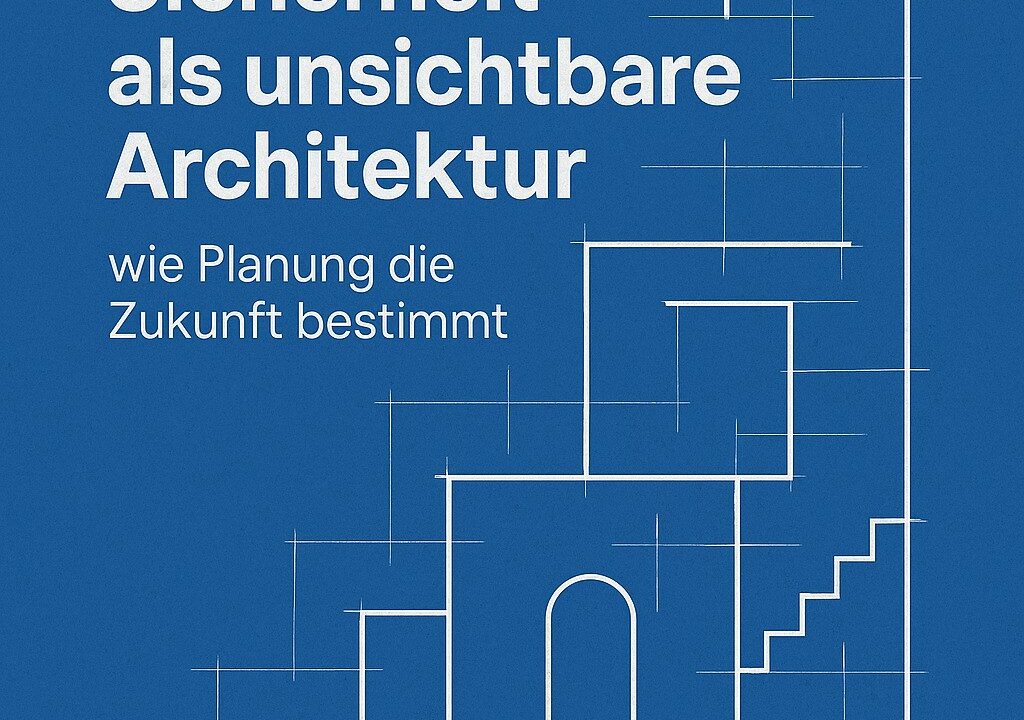
This invisible architecture is called safety.
And by that we don't just mean fire protection or a single law such as the Employee Protection Act (ASchG). We mean the entirety of technical corporate safety: fire protection, environmental protection, employee protection, compliance, authorities, insurance, capital - all of this forms the silent substructure that determines whether projects and companies really work.
Safety doesn't start with regulations - it starts with planning
The biggest mistake made by many building owners and contractors is to believe that safety is a downstream step: first build, then retrofit, then have it approved. But it is precisely this attitude that leads to delays, additional costs and uncertainty.
Anyone who integrates safety into the design makes it a design criterion. An escape route is then not just a line in the plan, but a designed element that clearly guides movement. Media separation in the warehouse is not just a regulation, but a logical structure that facilitates processes. And a fire protection concept is not just a file folder, but a navigation system that guides everyone involved through planning, construction and operation.
In this way, security becomes architecture in the invisible - just as important as statics or building services, but often underestimated.
The interplay of regulation and advantage
At first glance, many laws and standards seem burdensome. TRVB regulations, ASchG regulations, environmental regulations, insurance requirements - everything sounds like paper, like an obligation, like costs. But the truth is that they can give you a competitive advantage if you use them wisely.
- A clearly routed fire protection route saves time during an evacuation - but also during every inspection.
- An organized warehouse structure reduces risks - and insurance premiums at the same time.
- Transparent documentation in accordance with §82b of the Trade Regulations makes audits easier - and increases the trust of partners.
- An internationally compatible security concept (DACH → GCC/Africa) opens doors for global projects because authorities and investors understand the same language everywhere: Clarity, proof, trust.
From duty to freestyle - emotions as leverage
Why does ISO 9000 have such a positive effect, even though it is complex and expensive? Because it is voluntary - and because it generates pride.
Why does the ASchG have such a negative effect, even though it is also a management system? Because it is mandatory - and is associated with control.
This is exactly where we come in: We also tell the duty as a freestyle. We translate dry paragraphs into positive effects: Calmness, predictability, speed, pride, trust.
Peace of mind, because clarity is created and discussions disappear.
Predictability, because deadlines and budgets remain stable.
Speed, because approvals run smoothly.
Pride, because the team feels that it is working properly.
Trust, because authorities, insurance companies and investors recognize a line.
This attitude is also reflected in my book "Together instead of against each other". It is about an entrepreneur who only realizes that cooperation instead of confrontation makes the decisive difference when working with the authorities. It is precisely this idea that also characterizes the topic of security: not as resistance, but as a silent partnership.
Global Lessons - a common language of security
Whether in Europe, the Middle East or Africa, projects fail everywhere not because of a big fire, but because of small frictions. Because of unclear responsibilities, missing evidence, contradictory documents.
The good news: good technology has a common language.
A clear escape route, a cleanly separated storage area, consistent documentation - every authority, every insurer, every investor understands this.
In the DACH region, it is often TRVB and ASchG that form the basis. In the GCC or in Africa, it is international standards such as ISO or EN that build bridges. The decisive factor is not the paragraph, but the logic: making visible, organizing, anchoring.
From risk to resilience
Every project has risks. But risks are not the end, they are the beginning. If you use them to build resilience, they turn into advantages.
- A strict environmental requirement? Can become a differentiator - "we build more sustainably".
- An official test certificate? Can become a stamp of quality - "we have passed".
- An insurance requirement? Can become routine - "we reduce premiums and strengthen trust".
Resilience does not mean avoiding risks, but rather translating them into systems that make the company stronger.
STAR example from practice
Situation: A client is planning an extension to his production hall. Tight deadlines, many parties involved, high insurance sums.
Task: Integrate safety without delaying the project.
Action: Escape routes visibly routed in the design, storage separated according to media, fire compartments marked in the plan, TRVB checks introduced, ASchG routines simplified.
Result: Acceptance runs smoothly, insurers accept the documents without queries, operation starts without delay.
This is exactly how security is transformed from an obligation into an accelerator.
The way forward
For architects, builders, contractors and managers, safety is not something that you "also" have to do. It is the invisible foundation of every successful project.
We see ourselves as a technical consultant - like a tax consultant for finances or a lawyer for contracts. Only we take care of the issue that is underestimated in most companies: security.
Our offer:
- We check your planning for eligibility for authorities and insurance.
- We prepare due diligence checks for investors.
- We support international roll-outs and translate standards.
- We help turn risks into resilience.
After all, security is not just a block on the leg - it is the invisible architecture that supports companies.