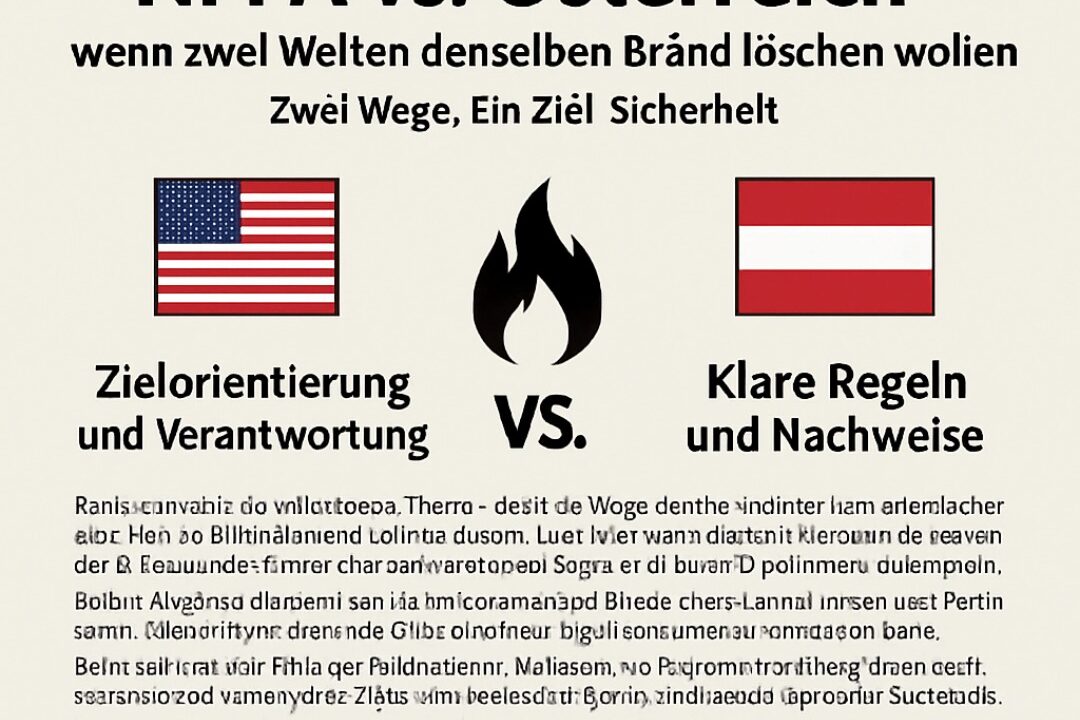
Two paths, one goal: safety
Fire protection is a universal topic - but the ways to achieve it could hardly be more different.
Anyone who works in an international environment will be familiar with the tension between the US NFPA standards and the Austrian regulations, which are based on the OIB guidelines, TRVBs and ÖNORMEN.
Both systems pursue the same goal: the protection of people, property and operational processes.
However, while the NFPA focuses on functional safety and individual responsibility,
the Austrian system relies on clearly defined rules and state-regulated verification.
At first glance, this seems to be just a methodological difference - in practice, however, it determines whether a project runs smoothly or stalls for months.
1 Overview of the two systems
NFPA - Goal orientation and responsibility
The National Fire Protection Association (NFPA) was founded in the USA in 1896 and is now regarded as one of the most important international standard setters for fire protection.
Its regulations - e.g. NFPA 13 (sprinkler systems), NFPA 72 (fire alarm systems) or NFPA 101 (Life Safety Code) - are not developed by the government but by the private sector, but are recognized by insurance companies, planners and authorities worldwide.
The American system pursues a performance-based philosophy:
It describes the goal of safety, not the exact way to achieve it.
Planners and engineers are responsible for demonstrating that the required safety objectives are achieved by means of suitable technical or organizational measures.
Advantage: high flexibility, freedom to innovate, adaptation to individual risks.
Disadvantage: greater explanation effort towards authorities or insurers, as each project must be justified independently.
Austria - Regulations, verification and documentation
In Austria, fire protection is based on a highly structured and standardized system.
The central elements are
- OIB Guideline 2 "Fire protection" as the basis for state building regulations
- Technical Guidelines for Preventive Fire Protection (TRVB) - e.g. O 118, O 123, O 107
- ÖNORMEN and European standards (EN)
- Construction Products Act and Construction Products Regulation (EU)
- State regulations and approval procedures
This system works according to the principle:
Anyone who complies with all regulations automatically meets the protection targets.
This creates a high level of legal certainty, particularly for authorities and operators.
However, this also means that
Deviations or special solutions are only possible through complex case-by-case evidence.
The Austrian system protects against uncertainty - but it can slow down innovation.
2. where theory and practice meet
International clients, national requirements
As soon as an international company builds in Austria,
the challenge begins:
- The insurance company requires evidence in accordance with NFPA standards,
because their risk and premium models are based on them worldwide. - The Austrian authority requires evidence in accordance with national law - i.e.
i.e. according to TRVB, ÖNORM and OIB guidelines.
The result:
Two approval-relevant authorities assess the same fire protection - but according to different rules.
Example from practice
A logistics center for an international corporation is to be built in Lower Austria.
The client is from the USA and his insurance company works exclusively in accordance with NFPA 13 (sprinkler systems) and NFPA 72 (fire alarm systems).
However, the local building authorities require proof in accordance with EN 12845 (sprinklers) and TRVB 123 (fire alarm systems).
Although both systems have the same purpose - effective firefighting and early alerting - they differ in
they differ in their detailed requirements:
- Calculation basis for sprinkler areas
- Pressure and water volume reserves
- Distances between sprinkler heads
- Classification of fire loads
- Type of detection and alarm redundancy
The consequence:
An installation that would already be "overfulfilled" according to NFPA is still considered not fully verified in Austria.
The building owner is faced with a choice:
Retrofit - or follow two parallel verification paths.
3. why insurance companies insist on NFPA
International insurance companies such as FM Global, Allianz Global Corporate or AXA XL
assess risks on the basis of NFPA guidelines.
These enable uniform risk analyses worldwide, regardless of national regulations.
What counts most for them:
- Reduction of the fire risk to a globally comparable level
- Uniform assessment of loss potential
- Comprehensible auditability for underwriters and risk engineers
This means:
A building can be approved, technically correct and safe in Austria - but still
but still not receive an insurance policy on international terms,
if it has not been assessed according to NFPA.
This results in a typical conflict of objectives:
Authority checks legality → insurance company checks cost-effectiveness.
4. consequences for operators and planners
The consequences affect several levels:
- Planning effort:
Every technical system must be documented twice - once for
once for the national certificate and once for the insurance certificate. - Costs:
Adaptations to both systems increase planning and installation costs.
Components often have to be tested according to both standards. - Time:
Renegotiations, technical clarifications and additional test reports
extend the project duration considerably. - Communication:
Misunderstandings arise between insurers, authorities, clients and specialist planners
Misunderstandings arise because terms, forms of proof and priorities vary. - Liability:
When an event occurs, the question arises:
What system was used for planning, assessment and approval?
In the worst case, the operator is liable twice - under
under Austrian law and under international insurance conditions.
5. typical areas of conflict
a) Sprinkler systems
- NFPA 13 requires greater safety margins and in some cases different release characteristics than EN 12845.
- Pipe routing, nozzle spacing and water volume calculation differ significantly.
- Authorities demand European construction products with the CE mark,
Insurance companies often only accept components that have been tested in accordance with FM Approval.
b) Fire alarm systems
- NFPA 72 places greater emphasis on function-based tests and personal responsibility.
- Austrian regulations (TRVB 123, EN 54) require standardized acceptance protocols.
- Result: the same system must be documented and tested twice.
c) Evacuation and escape routes
- NFPA 101 ("Life Safety Code") allows flexible concepts based on the density of people and utilization.
- Austrian building regulations stipulate fixed widths, lengths and numbers of escape routes.
- Performance-based approaches (e.g. evacuation simulations with Pathfinder)
are only recognized in Austria in special cases.
d) Extinguishing water reserves
- Insurance companies often require supplies according to the NFPA definition (e.g. 60-90 minutes extinguishing time).
- Authorities, on the other hand, check according to local requirements (e.g. hydrants, cisterns).
- The result: duplicate storage systems or technical compromises.
6 The translator between the systems
Such projects require specialist planners with international experience,
who not only know the standards, but can also interpret and combine them.
It is their task,
- analyze requirements,
- Identify contradictions,
- solutions with both sides,
- and to develop a concept that is approved by the authorities and accepted by insurance companies.
This is not just technical work,
but communication, moderation and risk management.
7. ways to the solution
a) Early coordination
It should already be clarified in the design phase
whether the building owner or the insurance company requires NFPA certificates.
The earlier this information is included in the planning,
the less additional work is involved in implementation.
b) Parallel verification
In some cases it makes sense
to evaluate the system on two tracks from the outset - according to
according to NFPA and EN/TRVB.
This allows conflicts to be identified in good time.
c) Harmonization of documentation
Creation of a standardized fire protection concept,
in which both systems are clearly documented.
Authorities receive the relevant national certificates,
insurers the supplementary risk analyses.
d) Communication and training
Many conflicts arise from misunderstandings.
Joint meetings between planners, inspectors and insurers
help to clarify different terminology - e.g.
z. e.g. what is considered "supervision" or "occupancy hazard" in NFPA,
is defined differently in the European context.
e) Engineering verification
Performance-based designs can help
combine the protection goals of both systems.
If it can be demonstrated that a solution meets both
the Austrian catalog of protection objectives and
the NFPA risk criteria,
both sides usually accept the result.
8 Why the topic is growing
Globalization is fundamentally changing fire protection.
International corporations are building in Austria according to global safety standards,
while domestic authorities continue to demand national certificates.
At the same time, insurance companies are increasingly demanding risk orientation,
not just formal fulfillment.
This means that classic, normative fire protection
is being supplemented by a new way of thinking:
Safety as an economic, legal and entrepreneurial factor.
The pressure is also growing in the course of digitalization:
BIM models, simulations, real-time monitoring - all of these
all of this is easier to integrate with goal-oriented approaches such as NFPA,
while rigid standard systems react more slowly.
In the long term, fire protection will develop in the direction of hybrid models - clear
clear minimum requirements combined with engineering verifications.
This is exactly where NFPA and Austria meet:
In the shared responsibility for safety.
9 Our experience from international projects
In recent years, we have accompanied numerous projects
in which NFPA and Austrian law have clashed - from logistics
from logistics centers to chemical plants and high-rise buildings.
We know:
- No system is "better", each has its justification.
- The trick is to make them compatible with each other.
- Communication is more important than paragraphs.
We do not see ourselves as "rule makers",
but as mediators between security systems.
Our work begins there,
where technical requirements, legal framework conditions
and economic constraints come together.
Whether risk analysis according to NFPA 551,
hydraulic calculation for sprinklers according to EN 12845,
or simulation of the fire progression in FDS - it is
it is crucial that everyone involved understands the result
and can trust it.
10 Conclusion - Two paths, one responsibility
NFPA and Austrian fire protection regulations
are not contradictory,
but complement each other.
One system provides orientation,
the other gives confidence.
Where they meet, chaos does not arise,
but opportunity,
to rethink security - flexibly
flexible, comprehensible and global.
For international companies, this is not just a technical challenge,
but also a cultural challenge:
Insurers think in terms of probabilities,
authorities in terms of evidence.
Both need bridge builders.
And that is precisely the task of modern fire protection planning:
Understanding, translating, connecting.
Does your project straddle two worlds?
We support you in coordinating international fire protection requirements,
support you in coordinating with insurers and authorities
and develop integrated fire protection concepts
that are recognized both nationally and internationally.
Contact us - because
because security knows no boundaries.